

Friday, 24th October 1913 Proof Of Charges Will Mean A New Trial, Says Court, The Atlanta Constitution

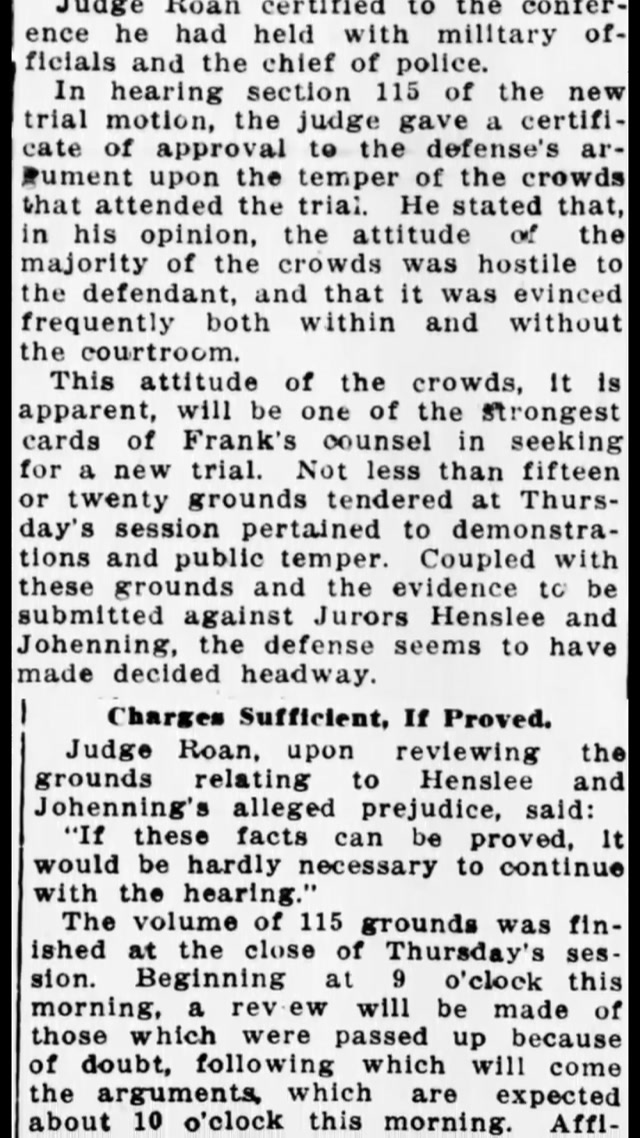
The Atlanta Constitution, Friday, 24th October 1913, PAGE 1, COLUMN 2. Evidence Against Jurors Henslee and Johenning the Most Important To Be Introduced. ATTITUDE OF CROWDS WILL BE STRESSED Verdict in Trial Was Delayed for Two Days on Account of Fear of Mob Violence, Roan Admits. It developed Thursday during Frank hearing for a new trial that the verdict in the original trial was delayed two days for fear of mob violence to the accused man. Also, that Judge Roan was prevailed upon by the editors of the three Atlanta newspapers, militia, officials and the chief of police to make this move of continuance. It was feared if the verdict was submitted on the trial's final Saturday, during which day the crowds were largest, that violence might result. During the close of the trial, while Solicitor Dorsey was ending his historical argument, Judge Roan ordered adjournment at noon on Saturday, August 2. This was his action to prevent any possible outbreak of the crowds. Had court not been adjourned at that time, the solicitor's speech would have been finished before nightfall and the verdict returned by earlier than 10 o'clock at night. Judge Roan certified to the conference he had held with military officials and the chief of police. In hearing section 115 of the new trial motion, the judge gave a certificate of approval to the defense's argument upon the temper of the crowds that attended the trial. He stated that, in his opinion, the attitude of the majority of the crowds was hostile to the defendant, and that it was evinced frequently both within and without the courtroom. This attitude of the crowds, it is apparent, will be one of the strongest cards of Frank's counsel in seeking for a new trial. Not less than fifteen or twenty grounds tendered at Thursday's session pertained to demonstrations and public temper. Coupled with these grounds and the evidence to be submitted against Jurors Henslee and Johenning, the defense seems to have made decided headway. Charges Sufficient, If Proved. Judge Roan, upon reviewing the grounds relating to Henslee and Johenning's alleged prejudice, said: If these facts can be proved, it would be hardly necessary to continue with the hearing. The volume of 115 grounds was finished at the close of Thursday's session. Beginning at 9 o'clock this morning, a review will be made of those which were passed up because of doubt, following which will come the arguments, which are expected about 10 o'clock this morning. Affidavits and other evidence will also be considered today. New Affidavits Presented. The defense sprang a surprised Thursday when they declared affidavits were in their hands contradicting Henslee's story that he was not in Albany, Ga., at the time he is alleged to have expressed bias. Colonel Rosser declared that he had evidence of Henslee's signature upon the hotel register and of an order which the accused juror took in Albany on the date in question. Upon the establishment of this, or jury prejudice, depends the success or failure of the new trial motion. Judge Roan, in telling of the delayed verdict for fear of an outbreak, stated that he had prevailed upon Continued on Page Seven. PAGE 7, COLUMN 2 PROOF OF CHARGES WILL MEAN NEW TRIAL Continued From Page One. By military officers and police officials to defer the end of the trial until the following Monday. This was done when it looked as though the verdict would be returned Saturday night. This was done, said the judge, because the temper of the crowd was obviously at high tension. I do not doubt that the prisoner might have suffered violence if proper steps had not been taken. Letters From Editors. Judge Roan was apprised of the defense's knowledge of a personal communication which the court had received during the trial from James R. Gray, of The Journal; Foster Coates, of The Georgian, and Clark Howell, of The Constitution, suggesting that the verdict be deferred until the following Monday. The judge was asked to certify to this. He would not, on the grounds that the communication was personal, but said that if the editors gave permission he would make the desired certificate. Neither would he certify to the section of the motion appealing for new trial on the ground that the defense was not officially represented when the verdict was returned. This clause was the subject of a stubborn battle between the defense and prosecution. Solicitor Dorsey maintained that Stiles Hopkins, a member of the Rosser & Brandon law firm, was present in the courtroom at the time the verdict was returned, and received it legally. To this Colonel Rosser replied that Hopkins was given no instructions to represent the defendant, and that no one connected with the defense was supposed to have been in the courtroom at the time it was read. Hopkins was called to the hearing to testify. He stated that he had received no instructions, as stated by Mr. Rosser. First Witnesses Heard. The first witnesses were heard Thursday. Mr. Hopkins was the first. Afterwards a newspaper reporter testified to the scenes outside the courtroom on the day of the verdict, when the solicitor was hoisted to the shoulders of a number of men in the crowd. A number of witnesses, it is said, will be put up today. An attack was made upon Judge Roan's charge to the jury in ground 73 of the new trial motion. His failure to charge the jury to put no credence in Conley's story because of admitted falsehoods was another contention in a following section. The ground relating to the alleged illegal charge reads as follows: The court erred in charging the jury as follows: Is Leo Frank guilty? Are you satisfied with his guilt? Are you satisfied with his statement? Are you satisfied with the evidence? Is his plea of not guilty the truth?' Object to Picket Letter. A plea is also based upon the injection into the solicitor's argument of a letter received from District Attorney C. M. Pickett, of San Francisco, bearing on the Durant case in California. It is alleged that the use of such material was illegal and prejudicial, and that the court was in error in not excluding it. References by Dorsey to Oscar Wilde, the Richeson and Beattle cases were also objected to. A vigorous protest was made to the solicitor's accusation that the expert medical testimony introduced by the defense was obtained by money and influence. In answer to this, Dorsey stated that he never made such an allegation: I only intimated it, he said. PAGE 9, COLUMN 3 PROFESSIONAL CARDS P. H. Brewster, Albert Howell, Jr. Hugh M. Dorsey, Arthur Heyman, Dorsey, Brewster, Howell & Herman, Attorneys-at-Law. Offices: 202, 204, 205, 206, 207, 208, 210 Kiser Building, Atlanta, Ga. Long-Distance telephone 3022, 3024, and 3025, Atlanta, Ga.
0 Comments
Comments live in community threads. Post this video to a community to start the conversation.