

Thursday, 7th August 1913 Dr. Harris Testimony is Attacked by Defense Expert, The Atlanta Journal

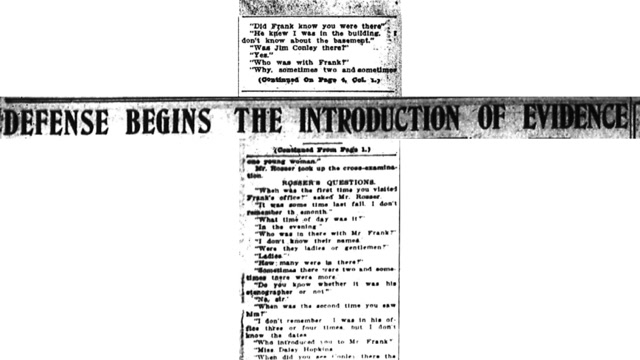
DR. HARRIS' TESTIMONY IS ATTACKED BY DEFENSE EXPERT STATE FINISHES TESTIMONY AND DR. LEROY CHILDS BEGINS EXPERT EVIDENCE FOR DEFENSE Dr. Childs Characterizes Conclusions Similar to Those Made by Dr. H. F. Harris and Dr. J. W. Hurt as Remarkable Guesses, He Says Cabbage Is Most Indigestible of All Vegetables and Might Stay in Stomach for Many Hours DEFENSE IS EXPECTED TO PUT UP CHARACTER WITNESSES IN VIEW OF JUDGE ROAN'S RULING Dalton Swears He Has Visited Pencil Factory in Company With Women, That Frank Knew of His Presence and That Jim Conley, the Negro Sweeper, Was There, He Tells of Frank's Visitors When recess was ordered at o'clock Wednesday in the trial of Leo M. Frank, charged with the murder of little Mary Phagan, Dr. Leroy Childs, called by the defense as its first witness, was on the stand. Dr. Childs had already testified in answer to a hypothetical question framed by Attorney Reuben R. Arnold, that a post mortem examination nine days after death would not show whether a blow on the head, such as that described by Attorney Arnold, had produced unconsciousness, or whether it had been delivered before or after death. Dr. Childs declared that such a blow as that described by Mr. Arnold might even have produced death. He characterized any statement to the effect that such a blow procured unconsciousness and that it could not have produced death, as nothing short of a remarkable guess. Dr. Harris also declared that cabbage was the most indigestible of all vegetables and that it might remain in the stomach as long as four hours and a half. Looking at the cabbage taken from the stomach of Mary Phagan and submitted as evidence at the Frank trial, Dr. Childs said that it was impossible to tell how long this food had remained in the stomach. Dr. Childs followed Dr. H. F. Harris, secretary of the state board of health, who was the concluding witness for the state. At the close of Dr. Harris' cross examination, the state rested. Answering the questions of Attorney Arnold, Dr. Harris reaffirmed the testimony given by him previously, namely, that Mary Phagan was killed within [less] than an hour after eating the cabbage and bread found in her [stomach; that the cause of her death was strangulation; that the blow] on her head produced [unconsciousness but could not have] produced death and that she had suffered violence immediately before she was killed. It is the evident purpose of the defense as shown by the testimony already drawn from Dr. Childs to vigorously dispute the evidence of Dr. Harris fixing the time of the little girl's death. Other medical experts, no doubt, will follow Dr. Childs. It is now believed that the defense will put Frank's character in evidence, as the state has already succeeded in making an attack upon it through the testimony of Jim Conley, the negro sweeper, and C. B. Dalton. Should the defense put up witnesses to prove Frank's good character, the state will be permitted to rebut this testimony with any evidence it may have that is detrimental to Frank's character. C. B. Dalton was the first witness called by the state Thursday morning. Attorney Reuben R. Arnold objected to each and every question directed to the witness, and every answer made by him, on the ground that his testimony would be irrelevant, immaterial and prejudicial. DALTON TESTIFIES. "I overrule your objection," said Judge Roan. "Go ahead, Mr. Dorsey." Dalton was sworn. "Do you know Leo M. Frank?" "Yes." "Do you know Daisy Hopkins?" "Yes." "Do you know Jim Conley?" "Yes." "Do you work at the National Pencil factory?" "No." "Have you ever been there?" "Yes, four or five times with Daisy Hopkins." "Did you go to the office?" "Yes." "Was Frank there?" "Yes." "Then did you go to the basement?" "Yes." "Where in the basement? The diagram was handed to the witness." Dalton pointed to the enclosure behind the partition alongside the boiler. "Did Frank know you were there?" "He knew I was in the building. I don't know about the basement." "Was Jim Conley there?" "Yes." "Who was with Frank?" "Why, sometimes two and sometimes one young woman." (Continued on Page 4, Col. 1.) DEFENSE BEGINS THE INTRODUCTION OF EVIDENCE (Continued From Page 1.) Mr. Rosser took up the cross examination. ROSSER'S QUESTIONS. "When was the first time you visited Frank's office?" asked Mr. Rosser. "It was some time last fall. I don't remember the month." "What time of day was it?" "In the evening." "Who was in there with Mr. Frank?" "I don't know their names." "Were they ladies or gentlemen?" "Ladies." "How many were in there?" "Sometimes there were two and sometimes there were more." "Do you know whether it was his stenographer or not?" "No, sir." "When was the second time you saw him?" "I don't remember. I was in his office three or four times, but I don't know the dates." "Who introduced you to Mr. Frank?" "Miss Daisy Hopkins." "When did you see Conley there the first time?" "About the first of January." "What was he doing?" "He was sitting near the door when I went in." "Was the door open when you came back out?" "Well, he got up and opened it." WENT DOWN LADDER. "Where did you go in the building with Daisy Hopkins?" The witness pointed again to the enclosure in the basement. "Did you ever go down these stairs here?" asked Mr. Rosser, indicating the back stairs which it had been testified were nailed up months ago. "No, I always went down this ladder," said Dalton, pointing to the ladder near the elevator. "Where have you lived for the last year, Mr. Dalton?" The witness gave an address on Hunter street. "Where have you worked this year?" "For the Western and Atlantic railroad." "What kind of work do you do?" "Carpenter work." "Where did you work last year?" "I worked for contractors." The witness enumerated several contract jobs on which he worked last year, he said. "Have you been absent from Atlanta in the last ten years?" "Not for more than a week at a time." "Whom else did you work for last year beside Mr. Heflin?" Witness mentioned a Mr. McGinnis. "Whom did you work for the year before that?" Witness named Mr. McGinnis. "Where did you live last year?" "331 East Hunter street." "Can you come any nearer telling the time when you met Frank in his office than sometime between September and December?" "I don't remember." IN THE AFTERNOON. "What time of day was it?" "Between 2 and 3 o'clock." "Was the window of his office open?" "Sometimes." "Were there any curtains on the windows?" "I never saw any." "You saw two windows in each office, didn't you?" "I don't know." "Which office did you go into, the inner office or the outer office?" "I went into the one next to the stairway." "Do you know where the desk is in Mr. Frank's office?" "I won't be sure, except I think I saw it sitting next to the wall." "Have you see Frank this year?" "No." "You haven't seen him since last fall?" "I have not." SAW CONLEY ON EVERY VISIT. "Did you see Conley each time you went through the factory?" "Yes, I saw him each time." "Who was the watchman, at the time you saw a watchman there? Was he a negro each time?" "Yes, he was a negro each time." "Who was the watchman you saw there this year?" "He was a negro." "When did you go there this year?" "I went once on Saturday night, I think it was in January." "Did you ever live in Walton county?" "Yes, sir, I lived there about twenty years." "Where did you go when you left there?" "Came here." "Were you absent from Walton county at any time while you lived there?" "Yes." "Where did you go?" "I went to various places." "Weren't you absent once for quite a long while?" "Yes, I was in Lawrenceville once for two or three years." "When was that?" "I don't remember." "Why did you go there?" "My father moved there and lived there a while." "Did you ever go to the factory with anyone besides Daisy Hopkins?" MET OTHER GIRLS. "No, but I've been to the corner there several times, near the Busy Bee, waiting to meet girls, and go home with them." "Whom did you meet there? Can you name some of them?" The witness mentioned several names. "Where were you born?" "I don't know." "Well, where were you when you waked up?" "I was in Lawrenceville, I think." "Up to ten years ago you lived in Gwinnett and Walton counties exclusively?" "Yes, the longest time I was away from home was two weeks, when I was in Alabama." Mr. Dorsey took up the re direct examination. "Did you pay Conley anything?" "Did you give Jim Conley any money?" "Yes, I gave him a quarter every time I was there." "When was that?" "About once a week for about six weeks." "Did Frank ever have anything to drink in his office?" "Yes, sometimes he would have cold drinks." "Did he ever have anything intoxicating?" "Yes, beer once." "Did you ever see any of the women up there doing stenographic work?" "No." By Attorney Rosser: "You say you saw beer there? Every time?" "No, not every time. Usually there'd be a waiter full of cold drinks there." The witness specified several soft drinks. BEER AND WOMEN. "Well, what women were there when he had the beer?" continued Mr. Rosser. "There were two besides Daisy Hopkins." "Describe them." "I didn't pay any attention to anybody but Daisy." "She must have been pretty," said Mr. Rosser. "Just as pretty as a girl can be," returned the witness. "Can you fix the date of the first visit any nearer than you have done?" "No, sir." The witness was excused, and City Detective S. L. Rosser was called. "Did you see Mrs. Arthur White on April 26?" "Yes." "When did Mrs. White first mention to you that she saw a negro as she came down out of the factory about on April 26?" Attorney Rosser objected. "When did you first know that she claimed to have seen a negro?" "On May 6 or 7." "Whom did you learn it from?" "From her." "Did you ever ask her about a negro?" asked Attorney Rosser. "I don't think so. She volunteered the information." Before the witness was excused Solicitor Dorsey asked: "Did you search around the elevator on the first floor of the factory?" DIDN'T FIND BLUDGEON. "Yes, on Monday or Tuesday." The bloody stick said to have been found by the defense, and an umbrella handle, were exhibited to the witness by the solicitor. "Were these there when you made the search?" asked the solicitor. "No, sir." "You took some chips to Dr. Claude Smith, didn't you?" "Yes." The solicitor exhibited some chips and asked: "Are these the chips?" "They are the same." Attorney Rosser: "You mean they look like the same?" "No, they are the same." BLUDGEON THERE TWO YEARS? "Don't you know that this roller," continued Attorney Rosser, referring to the bloody stick, "had been down there for two years?" "It was not there when I made the search." The witness was excused. Solicitor Dorsey tendered in evidence the bloody shirt found by the detectives at Newt Lee's house. There was no objection. The solicitor tendered the chips in evidence. Attorney Rosser objected, saying that they had not been identified properly. Judge Roan said, "That's for the jury to judge. We'll let them in." "Now, your honor," said the solicitor, "we want the cash book and the bank book showing the cash on hand April 26 and the deposits on about Monday or Tuesday or any time during the following week; and the officials of the National Pencil company have promised to produce them. I ask your honor to help me get them here." COURT TAKES RECESS. "There'll be no trouble about getting the books. We'll get them here," said Mr. Arnold. "When we get these books here, and when Dr. Harris has finished his testimony, the state will rest," said Solicitor Dorsey. The solicitor explained "Dr. Harris can't sleep at night, and it was with difficulty that I got him here at all. He has promised to come down some time during the day." Mr. Dorsey intimated that he expected the defense to go ahead, and that Dr. Harris could be interposed. Mr. Arnold and Mr. Rosser preferred not to do that, and Dr. Harris was called by telephone at his residence, agreeing to come into court at 10 o'clock. Court recessed until that hour, at o'clock. DR. HARRIS ON STAND. Dr. Harris arrived in court at o'clock and the jury was brought back and resumed its place. Dr. Harris went upon the stand. Mr. Arnold resumed his cross examination of the witness. Dr. Harris admitted that nervous influences and certain things taken on the stomach retard digestion, but declared that nobody knows to what extent it is retarded. There is very little known on the subject, he said. He continued that some people say that sleep retards digestion while others say that it aids it. It is the same way with walking after a meal. He himself has not experimented much along this line, said he, and it would be only after long and tedious experiment that any definite data could be obtained. He admitted that mental activity retards digestion to some unknown extent. Little, if anything, said he, can be told about the process of digestion by external indication when a person suffers very much from indigestion, but many people suffer mildly from indigestion for years without knowing it. Dr. Harris said that medical men generally assume that blood goes toward the stomach to aid digestion; that there is more blood there while digestion is going on. SOMETHING NOT DEFINITE. He said that there are no definite facts known as to how long it takes substances not digested to pass out of the stomach. It is recognized that some substances are neither digested nor emulsified while they are in the stomach. Mr. Arnold asked him if cabbage stalks do not sometimes pass out of the stomach without ever having been affected. He said that they do not pass out that way from a normal subject. He admitted that grains of corn and peas, when swallowed whole, might not be affected even by a normal stomach. He said that nobody can tell where most vegetables are digested. Parts of vegetables are digested in one place, and parts in another, he said. Mr. Arnold asked if digestion is not the most mysterious thing with which medical men have to contend. "It is not," said Dr. Harris. Mr. Arnold asked if man is not the only animal that is omnivorous, except possibly pigs. Dr. Harris said that cats, he thought, are omnivorous, although they eat very little meat. "I have always understood," said Mr. Arnold, "that the feline species is the most carnivorous of all. Does a wildcat eat anything but meat?" "I don't know. I have never associated with them." "How about monkeys?" asked Mr. Arnold. "They don't eat flesh to any extent, although they do eat insects." CITES FAMOUS CASE. Dr. Harris admitted that the investigations of Alexis St. Martin in a famous Canadian case led up to all digestive experiments. "Isn't the study of digestion in its infancy?" asked Mr. Arnold. "I wouldn't say that," replied Dr. Harris. "You don't know the effect on man's digestion as well as you know the effect on animals, do you?" "You do as far as the stomach alone is concerned," said Dr. Harris. "What is laid down by science as the hardest vegetable to digest?" "I never heard of any." "Well, isn't cabbage laid down as one of the hardest?" "I have seen that statement but experiments have shown that it does not necessarily prove true." Attorney Arnold read a transcript of the evidence of Dr. Harris on direct examination, relating to his examination of Mary Phagan's stomach. "What did you find out about the bread you found there?" "Practically speaking, there had been no digestion of it at all." "Did you call in any other chemist to make these tests?" "No, sir." "You did it all yourself, then?" "I did." ONLY IN STOMACH HALF HOUR. "And you didn't call in any representative of this man?" "No, sir." "All you are willing to say is that this material in the stomach had been acted on only half an hour. You wouldn't undertake to say that it had only been in the stomach that long, would you?" "Yes, I would. It couldn't have been in there longer and not been subject to digestion." Dr. Harris reiterated that there was absolute evidence that the little girl had suffered violence of some kind. "Dr. Hurt made a visual observation. Was the dilation noticeable to him?" asked Mr. Arnold. "He could not have seen with his eye all that I saw with the microscope." Dr. Harris continued that he found dilation of the blood vessels or hemorrhages in the tissue. "These hemorrhages, doctor, were they visible to the eye?" "No, I observed them under the microscope." "And you couldn't tell by visual examination, whether there were hemorrhages present or not?" "No." "And there were hemorrhages scattered through the tissues?" "Yes, sir." "And the blood vessels and tissues were swollen?" "Yes, indicating diffusion of the blood." "Could you see the blood vessels with the naked eye? Not it was necessary to use a microscope." "How much were these blood vessels swollen?" BLOOD VESSELS ENLARGED. "Perhaps two thirds more than their normal size. Maybe double." "There is no way to determine what was their natural size?" "No, not definitely." "If I get a bruise on my hand, could you look through the microscope and tell whether the blood had come out of the vessels or not?" "Yes, sir." "I believe you said in your testimony about the skull wound that there was no pressure on the brain?" "Practically none." "Was the cut through to the skull?" "Oh, yes." "Well, what arteries were cut?" "There are only small arteries there." "Well, bleeding comes from the veins and arteries, does it not, doctor?" "Yes." "Well, what artery was on the skull at the base of this wound?" "There was no particular large artery under it." "Did you notice any blood vessels under the wound?" "Not especially. There are, of course, blood vessels, veins and small arteries at that point on the skull." "A wound bleeds more at first, doesn't it, and the flow of blood diminishes with time?" "Yes, sir." "Right where the injury was inflicted you would expect to find the greatest flow of blood?" "Yes, sir." "You say this injury couldn't have produced death?" "No, sir, certainly not." "Did you find any blood on the brain inside the skull and beneath this wound?" "Yes, sir, I found about one drop of blood, a sort of effusion." "This wound couldn't have affected the mental or bodily functions?" "Not so far as the killing is concerned." Mr. Arnold concluded his cross examination. Solicitor Dorsey asked some additional questions. "With reference to these poisons that Mr. Arnold asked you about yesterday, doctor, did you find any poison in any of the membranes?" "No, sir, there couldn't possibly have been any irritating poisons such as carbolic acid, bichloride of mercury, or other poisonous salts. If there had been they would have shown up on the membranous surfaces." "Your examination would have developed this fact?" "Yes, sir, any quantity of these poisons sufficient to produce an effect would have been noticeable." CABBAGE IN EVIDENCE. Solicitor Dorsey offered in evidence the samples of cabbage, first the little jar containing the cabbage taken from Mary Phagan's stomach; second, the two jars of cabbage taken from the stomachs of other persons, alive. Mr. Arnold was willing to admit the sample taken from the dead girl's stomach, but objected to the others as illegal, irrelevant and immaterial. He said that the conditions of these other stomachs had not been shown to be the same as the condition of Mary Phagan's stomach. Solicitor Dorsey insisted that the cabbage had been cooked in the same manner for the other subjects; that it had been eaten in the same manner; that it had remained in the stomach a definite period; that these other stomachs were normal. "We don't want to argue it," said Mr. Arnold. "We merely want to get our objection into the record." Judge Roan permitted the introduction of the exhibits. Solicitor Dorsey then called on the defense for the pencil factory cash book and financial statements. They were not in court, and the solicitor announced that the state rested its case. It was agreed among the attorneys that three witnesses for the state, N. V. Darley, E. F. Holloway and Harry Scott, could be called back to the stand by the defense. DEFENSE OPENS WITH CHILDS. Dr. Leroy Childs, the first witness for the defense, branded as a couple of remarkable guesses the testimony by Dr. Harris and Dr. Hurt, who were witnesses for the state. Dr. Childs stated that he is a surgeon, and has been engaged in the practice of medicine and surgery in Atlanta for the past five years. He graduated from Michigan, said he, in 1906, served later in a hospital. Mr. Arnold asked the witness this hypothetical question: "Say a body was found at 3 o'clock and rigor mortis was not complete. It was embalmed at 10 o'clock. It was taken up nine days later and a post mortem performed. Behind the ear was a wound cutting through to the skull, which one doctor says was 2 1-4 and another said was 1 1-2 inches long. There was a single drop of blood on the inside of the skull, but this did not in any way affect the brain or brain tissues. Could a physician performing this post mortem say definitely that this blow produced unconsciousness?" ONLY A GUESS, HE SAYS. "He could simply hazard a guess," said Dr. Childs. "Would a blow on the body after death produce the same effects as a blow before death?" "Yes, if it was inflicted within a [certain time]..."
0 Comments
Comments live in community threads. Post this video to a community to start the conversation.