

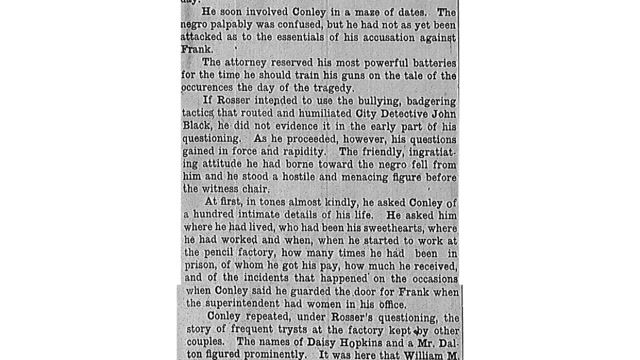
Monday, 4th August 1913 Rosser’s Grilling of Negro Leads to Hot Clashes by Lawyers, The Atlanta Georgian

A bitter, determined cross-examination of Jim Conley by Luther Rosser was marked by a prolonged battle between counsel for the defense and State over the method of questioning the negro. The defense won a complete victory, Judge Roan ruling that the accuser of Leo Frank could be cross-examined on any subject the prisoner's lawyers saw fit. In the course of this legal tilt Luther Rosser said: "I am going after him (referring to Conley) and I am going to jump on him with both feet." Turning to counsel for the State he added significantly: "And I won't enlighten him, either. Your period of enlightenment is over." Rosser, before the afternoon session concluded, got the negro to say that he had been lying when he said that he got up at 9 o'clock the day of the crime. He said he got up at 6 o'clock. He admitted he lied when he said he left home at 10 or 10:30 in the morning. It was about 7, according to his story before the jury. He could not remember that he had told Harry Scott that he stayed on Peters street that morning until 11 o'clock. It wasn't so, anyway, he declared. Two gleaming rows of teeth were exposed and his face broke into a broad smile when he said to Rosser: "Jus' you read me them things that you got in them papers and I'll tell you whether I said them or not." At the close of the afternoon session Conley was declaring that all of the statements he had made on the stand were the truth, but that there were falsehoods in each and all of his affidavits. It is understood that the cross-examination of the negro will continue through the forenoon session Tuesday. He soon involved Conley in a maze of dates. The negro palpably was confused, but he had not as yet been attacked as to the essentials of his accusation against Frank. The attorney reserved his most powerful batteries for the time he should train his guns on the tale of the occurences of the day of the tragedy. If Rosser intended to use the bullying, badgering tactics that routed and humiliated City Detective John Black, he did not evidence it in the early part of his questioning. As he proceeded, however, his questions gained in force and rapidity. The friendly, ingratiating attitude he had borne toward the negro fell from him and he stood a hostile and menacing figure before the witness chair. At first, in tones almost kindly, he asked Conley of a hundred intimate details of his life. He asked him where he had lived, who had been his sweethearts, where he had worked and when, when he started to work at the pencil factory, how many times he had been in prison, of whom he got his pay, how much he received, and of the incidents that happened on the occasions when Conley said he guarded the door for Frank when the superintendent had women in his office. Conley repeated, under Rosser's questioning, the story of frequent trysts at the factory kept by other couples. The names of Daisy Hopkins and a Mr. Dalton figured prominently. It was here that William M. Smith, Conley's lawyer, told the newspaper men that Dalton was in the courthouse and would be called to corroborate these details of the negro's story. There were no women in the courtroom at the afternoon session, Judge Roan having issued an order barring them. As black and revolting a story as ever told to a (Continued on Page Two, Column 1.) PAGE 2, COLUMN 1 CONLEY TELLS OF DISPOSAL OF PHAGAN GIRL'S BODY Factory Sweeper Recites Details of Tragedy, Accusing Leo M. Frank NEGRO REPEATS CHARGE THAT ACCUSED MAN ASKED HIM 'WHY SHOULD I HANG?' Continued From Page 1. Georgia jury held a packed courtroom bound with horror and irresistible interest Monday. Leo M. Frank, brilliant young superintendent of the National Pencil Factory, was pointed out as the brutal murderer of little Mary Phagan and a degenerate of the worst type. James Conley, an illiterate negro leveled his finger at Frank in the prisoner's chair and said: "That's the man!" It was Conley's story for which an eager public a morbidly curious public, perhaps had been waiting. The story came with an unexpected wealth of horrible detail. The negro forgot nothing, omitted nothing that he had told before. If he was telling a black lie to save his own neck from the gallows, it was still more wonderful. He had a remarkably retentive memory or an imagination far beyond the normal even for his notably imaginative race. Frank told him he had killed the girl accidentally. That was the negro's first and entirely new damning accusation against the young factory superintendent who sat eyeing him coolly and impassively. Conley followed this charge with a thrilling narrative of the gruesome events of that day at the factory in which he said he had a part. "He said he had struck her too hard when she fought back at him and that she had fallen back and hit her head against something," was the negro's statement in effect. As every spectator in the crowded courtroom hung on his words, Conley unfolded his dramatic story. He related the details already familiar to the public and added to them a story of revolting actions unprintable in their nature which he ascribed to the young superintendent. Glibly he recited his tale of horror. So fast the words fell from his lips that the stenographers were hard put to keep up with him and the jurors, straining forward in their seats, found difficulty in following his recital. Gripped Audience With Story. He sat there, an uncouth, thick-lipped ignorant negro, but he told a story that gripped his auditors with a compelling interest that an eloquent-tongued orator could not have aroused. Clad in a suit of clothes which the officers only recently got for him to take the place of those he had worn ever since the time he was arrested, he entered the courtroom with the shadow of a smile on his lips. He was pleased with the interest he was attracting. What did anything matter so long as he was the center of the white folks' interest now. A blue shirt, newly laundered, but ill-fitting, was unbuttoned at the throat. He carried his old cap in his hands as he made his way half proudly to the witness box. He detailed each move from that time until Frank went to Montag's and returned and carried his thrilling narrative along to the moment when Frank, he said, called him from the top of the stairs on the second floor and directed him to go back and get a girl whom he had struck too hard and who had hit her head against something. From that point he related in minute detail a story of carrying the body, with Frank's help, to the front of the building and down the elevator. Tells of Disposal of the Body. An audience sat spellbound as he narrated the ghastly story of bundling the limp body into some crocus bagging and starting on his trip to the basement. Unconcernedly, as though it were an everyday matter, he told of the burden becoming too heavy and of Frank coming with an oath on his lips to help him. When he had finished this grisly portion of his testimony, he was asked concerning Frank's actions at other times. He responded with a revolting story on incidents which he said had occurred in Frank's office and in the metal room. There was nothing lacking of the dramatic. The very cord that was found about the neck of the murdered girl was given the negro and he threw it about his own black neck. He showed exactly where it made its deep impress in the tender neck of the little factory girl. He drew the noose tighter and tighter. Frank looked on quietly with never a quiver of his features. As he slipped it taut about his neck he demonstrated the exact position of the rope as it according to the State's contention, strangled the life of the girl. Other Women Figure in Details. He told of other times when he said Frank had made appointments with women at the factory. He told of alleged incidents in Frank's office at which the young superintendent's wife hung her head in momentary shame, her face bathed in crimson. He recalled a Thanksgiving Day in particular when a tall, heavily built woman entered the factory and he was instructed to watch the door for inopportune visitors. He declared it was this duty he was performing on the first floor of the factory when Mary Phagan came to her death. Only once during his narrative was there a lightening of the tragic interest with which it was hedged. This was shortly after the cross-examination had begun. Frank and his wife both laughed heartily when Attorney Rosser facetiously referred to Frank A. Hooper, admittedly the Beau Brummell of the trial lawyers, as "that old weazened-up fellow with the gray hair." TRIAL JUDGE L. S. ROAN Conley was trying to describe the color of the hair of Daisy Hopkins, one of the girls figuring in the testimony. He pointed out that of Attorney Hooper as most like that of the girl. A ripple of laughter arose in the courtroom in which the prisoner and his wife joined. PAGE 2, COLUMN 2 Conley's Story In Detail; Women Barred By Judge There was a murmur of excitement following the calling of Jim Conley; there was a wait of several minutes, officers having just left the police station with the negro a minute or two before he was called. Judge Roan impatiently ordered the Sheriff to bring in the witness. A number of spectators who were crowded up too close to the jury box were moved back by the court deputies. "The Sheriff hasn't got Jim Conley," said Attorney Rosser, after a statement from Deputy Sheriff Plennie Miner. "Mr. Starnes will bring him in," returned Solicitor Dorsey. "See if Mrs. White has arrived," then requested Dorsey. "She has a very young baby, and when I had her subpoenaed this morning she said that she would have to send to the factory and get her husband before she could come." Courtroom Quiet as Conley Enters. "You may call her later," said Mr. Rosser, "there won't be any objection." Jim Conley was brought into the courtroom just at this time. He took the witness chair and was sworn in while in the chair. Solicitor Dorsey examined him and everyone leaned forward, while extreme quiet prevailed. Q. What is your name? A. James Conley. Q. Do you know Leo M. Frank? A. Yes. Q. Point him out. (Conley did so.) Q. Did you have any conversation with him on Friday afternoon before the murder of Mary Phagan? (Conley's answer was indistinct.) Q. How long had you been working at the pencil factory? A. About two years. "Frank Told Me to Come Back." Q. What did he say to you on Friday? A. He said for me to come back at 8:30 o'clock Saturday morning. Q. Did you go? A. Yes, about 8:30 o'clock. Q. Who got there first, you or Mr. Frank? A. We met at the front door. Q. What did he say? A. He said I was too early for what he wanted me to do. I told him I thought he wanted me to do what I had been doing on every Saturday. Q. What had you been doing on other Saturdays? "I object," said Rosser. "This witness should not be led." Q. What did you do this Saturday? A. I watched the door while Mr. Frank said he was going upstairs for a little chat. Q. Was anybody else with him? "I must object again," interrupted Rosser. Q. Who was there? A. Well, girls would come up. One time another man and another girl come up. Q. What sort of looking woman was she? A. She was a heavy woman. Q. What time was this? A. Thanksgiving day, 1912.
0 Comments
Comments live in community threads. Post this video to a community to start the conversation.