

Thursday, 2nd October 1913 115 Reasons Given Why Frank Should Get Another Trial, The Atlanta Constitution

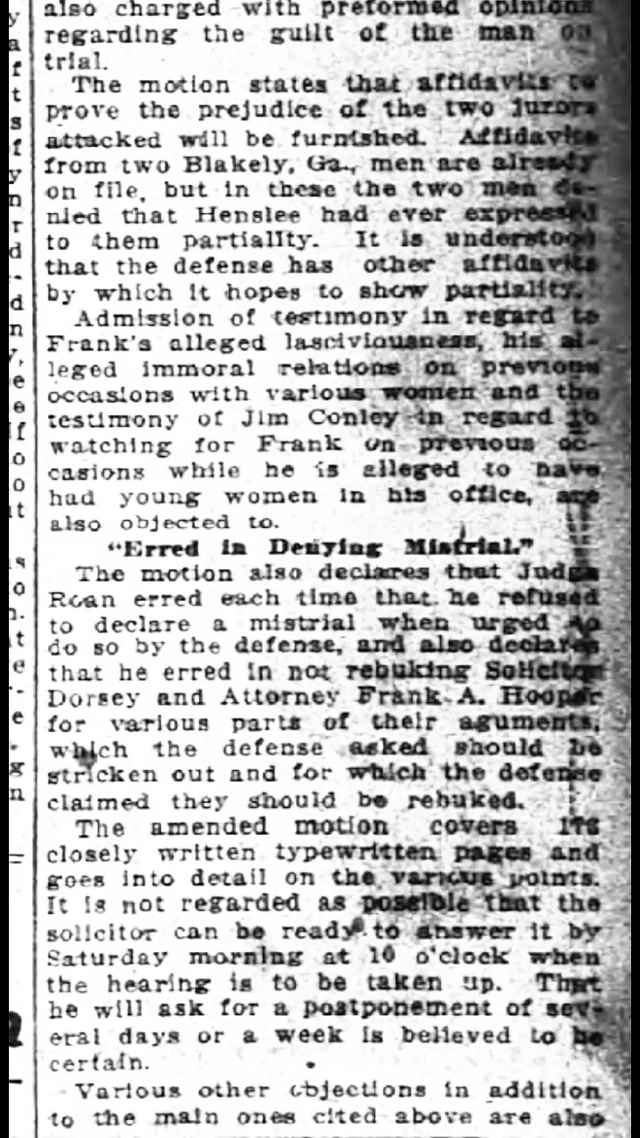
Hearing Is Set Before Judge Roan Next Saturday, But It Is Believed the Solicitor Will Ask Postponement. TWO JURORS ATTACKED IN RETRIAL PETITION Henslee and Johenning Declared "Prejudiced" — Object to Alleged Illegal Evidence and to Demonstrations. Charging that two members of the jury, Henslee and Johenning, were biased and prejudiced against the defendant; that Judge L. S. Roan admitted illegal evidence, prejudicial to the defendant, and that the popular applause from time to time, in and outside of the courthouse, influenced the jury and made it impossible for them to give him a fair trial, attorneys for Leo M. Frank, convicted of the murder of Mary Phagan, have prepared their amended motion for a new trial. The hearing is set for Saturday morning, and, if heard at that time, Judge Roan will probably preside. At Attorney Rosser's office Wednesday afternoon, it was stated that the intentions had been to serve the motion upon Solicitor General Hugh M. Dorsey at noon Wednesday, but the motion had not been finished in time. It was stated that the service would be perfected Wednesday night if possible. At a late hour Wednesday night the solicitor declared he had not been served with the motion. It is expected that service will be made today. Attorney Leonard Haas, who, with Attorneys Reuben R. Arnold, Luther Z. Rosser and Herbert Haas, represent the prisoner sentenced to hang on October 10, will today serve the solicitor with a stenographic copy of the entire proceedings of the trial, including the testimony of the hundreds of witnesses in the trial, which covered nearly a month. Formal Motion Some Time Ago. The formal motion for a new trial for Frank was filed on the day that he was sentenced. That was in skeleton form, and the amended motion, which carries the detailed and enlarged reasons, was the one with which the solicitor will be served tonight at his home. There are 135 instances cited as reasons for which the prisoner should be tried again. The main ones consist in the charge against the two jurors and the alleged illegal rulings of Judge Roan. In the motion, Juror Henslee is referred to as J. A. Henslee, while at the time of the trial his name was given as A. H. Henslee. This is regarded as a stenographic error. M. Johenning, the other juror attacked, is also charged with preformed opinions regarding the guilt of the man on trial. The motion states that affidavits to prove the prejudice of the two jurors attacked will be furnished. Affidavits from two Blakely, Georgia, men are already on file, but in these the two men denied that Henslee had ever expressed to them partiality. It is understood that the defense has other affidavits by which it hopes to show partiality. Admission of testimony in regard to Frank's alleged lasciviousness, his alleged immoral relations on previous occasions with various women and the testimony of Jim Conley in regard to watching for Frank on previous occasions while he is alleged to have had young women in his office, also objected to. Erred in Denying Mistrial. The motion also declares that Judge Roan erred each time that he refused to declare a mistrial when urged to do so by the defense, and also declared that he erred in not rebuking Solicitor Dorsey and Attorney Frank A. Hooper, for various parts of their arguments, which the defense asked should be stricken out and for which the defense claimed they would be rebuked. The amended motion covers nine closely written typewritten pages and goes into detail on the various points. It is not regarded as possible that the solicitor can be ready to answer it by Saturday morning at 10 o'clock when the hearing is to be taken up. That he will ask for a postponement of several days or a week is believed to be certain. Various other objections in addition to the main ones cited above are also contained in the motion. A condensed statement of the objections made is as follows: The allowing of Newt Lee to testify that Detective John Black talked to Lee longer at the station house than did Defendant Frank. That the court allowed Lee to show that Frank talked to him a shorter time than he (Frank) did to Attorney Arnold. That the court allowed Detective Starnes to testify that Lee, on the morning of his arrest, was quiet, and not unnerved, and that the solicitor was later allowed to draw conclusions about Frank's alleged nervous condition when approached by officers. Many Errors Alleged. That the court allowed Detective Starnes to swear that Frank was guarded in his conversation with the officers. That the court admitted the solicitor's diagram of the National Pencil factory in which the solicitor had drawn dotted lines showing his theory of where the girl was killed, and how the body was disposed of. That the court permitted Detective Black to testify that in a conversation several months before with him Frank showed no nervousness. That the court permitted it to be shown that Frank employed Attorneys Rosser and Haas about 3 o'clock on Monday morning after the murder. That the court refused to allow Detective Black to tell on cross-examination that Lee had said that the bloody shirt found in his home was his own property. That the court allowed Witness N. V. Darley to testify on the morning of his arrest Lee was composed. That the court refused to rule out the testimony made by Conley as to the previous alleged watching for Frank, and also in regard to Frank's alleged acts in having young women in his office. Meeting Was Blocked. That the court admitted evidence in regard to Conley's being taken to the jail to see Frank, and failing to see him, despite his own wish and that of the officers. It is cited that the inference was drawn by the solicitor that Frank had refused to confront his black accuser, and Mr. Dorsey, in his argument, asserted it was the first time in the history of the white race that a white man, charged with crime, refused to see his accuser, and particularly when that accuser was a member of the lower race. That the court allowed Mrs. Arthur White, wife and relative of the Frank's employees, to tell that she had reported, not to the police, but to the pencil factory people, that she had seen a negro lurking in the factory on the day of the murder. That the court allowing Sheriff C. W. Mangum to tell of Frank's refusing to confront Conley when the detectives and policemen brought the negro to the jail to put them face to face. That the court allowed Dr. H. F. Harris to testify in regard to experiments made with cabbages on patients and also that medical men must draw conclusions not from an isolated case, but from the general result of their scientific knowledge. Dr. Harris' Testimony. That the court allowed Dr. Harris to testify that from a microscopic examination of the girl's stomach that he could tell she had eaten the cabbage and bread within three-quarters of an hour before she died. That the court allowed C. B. Dalton to testify that he had visited the pencil factory and had seen Frank drinking with women in his office. That the court allowed Detective Bass Rosser to testify that he had frequently interviewed Mrs. Arthur White, and that not until several weeks after she told the pencil factory people did she tell him that she had seen a negro lurking around the factory on the day of the murder. That when the court declined to rule out part of Conley's testimony relating to Frank's alleged lasciviousness there was loud and persistent hand-clapping and other applause in the courtroom, and that the jury in the anteroom must have heard this applause, and the court refused to grant a mistrial. That the court did not clear the courtroom of the crowd, which contained those filled with passion and prejudice against Frank, and whose very presence was a menace to the jury. Reference is here made to the jeering laugh of part of the crowd when Attorney Arnold commented on part of the solicitor's remarks and to the fact that Judge Roan did threaten to clear the courtroom. Other references to applause at various times in the courtroom is also made. Cabbage Objected To. That the court allowed the introduction of certain bottles containing cooked cabbage which were said to have been prepared in a similar way to those eaten by the murdered girl and which were said to have remained in the stomach of certain parties for thirty to fifty minutes before being pumped out. That the court allowed Pinkerton Detective Harry Scott to testify that he got no information from any officials of the National Pencil company that Conley could write, at the time the negro was denying this. That the court allowed Solicitor Dorsey to comment on Herbert Schiff, a witness for the defense, in a way that reflected on his integrity. That the court allowed Miss Hall, a stenographer, to testify that on the morning of the murder Frank told her over the telephone that he wanted her to help him, and that he had so much work to do and it would take him until 6 o'clock. That the court allowed Solicitor Dorsey to examine Frank Chambers, a 15-year-old witness, in such a way as to insinuate that Frank had committed acts of perversion with him. That the court ruled out the testimony of Mrs. Freeman in which she told that Lemmie Quinn, a factory employee, had come to the restaurant where she was eating at o'clock that Saturday and told her that he had just left Frank. Would Bring Witnesses. That the court allowed Solicitor Dorsey to declare to the jury that he was not "flour-flushing," but that he was going to bring witnesses to show Frank had committed immoral acts with girls. That the court allowed Sig Montag to testify that the pencil factory had employed the Pinkertons, but had not yet paid them. That the court allowed Car Inspector Leach to testify that he had known of instances where motormen and conductors brought their cars to the center of town several minutes ahead of time. That the court allowed the solicitor's frequent references to Frank's attitude toward women, which is not one of the character traits involved in a plea of murder, even when the defendant has put his character at issue. Examination of Pinkertons. That the court allowed the solicitor to examine Pinkerton Detectives Whitfield and McWorth in a manner indicating that the alleged failure of the Pinkertons to report the finding of a bloody club to the police was detrimental to Frank; that the court did not instruct the jury that these detectives were employed by the National Pencil company and not by Frank and that the defendant was not bound by what they did. That the court permitted Irene Jackson to testify to an alleged visit of Frank's to the dressing room of his female employees while the said employees were in the room. That the court allowed Harlee Branch to tell of accompanying detectives and Conley when the negro went through at the factory with what was alleged to be a pantomime of the action of himself and Frank in disposing of the dead girl's body. Said Wages Were Raised. That the court allowed E. H. Pickett to testify of certain admissions he is alleged to have secured from Minola McKnight, in which she said her wages had been raised by the Selig family. That the court allowed Misses Maggie Griffith, Myrtis Cato, Marie Carst, Nellie Petty, May Davis and Estelle Winkle, and Mesdames C. D. Donagan, H. R. Johnson and E. Wallace to testify that they were acquainted with the general character of Frank in regard to women previous to April 26, 1913. That the court allowed L. T. Kendrick, a former employee of the pencil factory, to testify regarding the reliability of the factory clock. That the court refused to grant a mistrial after the solicitor's argument and before the judge's charge to the jury, when the defense asked it on the grounds of the popular demonstration on the streets over Solicitor Dorsey. That the court allowed Attorney Hooper, for the state, to argue to the jury that the failure of the defense to cross-examine certain female witnesses was strong evidence of the fact that if the defense had cross-examined them they would have related instances of Frank's alleged misconduct with women. Jurors Are Attacked. The same objections are made to parts of the solicitor's arguments to the jury. That Juror Henslee was not a fair and impartial juror, and was prejudiced against the defendant when he was selected as a juror, and had previously formed and fixed an opinion as to the guilt of the defendant and was biased in favor of the state when chosen. Practically the same charges are made against Juror Johenning, and the motion declares that affidavits proving this will be furnished to the court. That the court refused to include in the charge to the jury a number of points insisted upon by the defense, and particularly in not leaving it to the jury to say whether or not Conley was an accomplice, and instructing the jury that if they found that Conley was an accomplice that it would be necessary to have the testimony of some other party besides Conley to show Frank's guilt. The motion contains long extracts from various portions of the testimony referred to and cites quotations from legal decisions in regard to the points at issue. It also gives extracts from the solicitor's speech, and contends that various remarks of his when interrupted by Attorney Arnold were illegal and improper.
0 Comments
Comments live in community threads. Post this video to a community to start the conversation.